Greater Israel is Becoming Reality - And it's Implications Are Terrifying
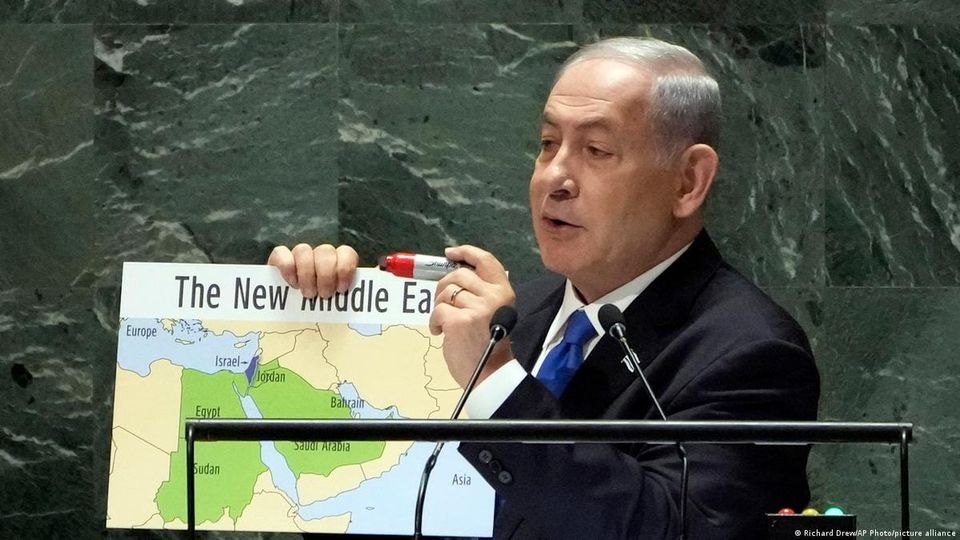
For more than a century, the concept of “Greater Israel” has been associated with zealous Jewish and Christian Zionist ideologues. Today, it's become downright mainstream - and I don’t think it’s hyperbole to suggest that this extremist ideology is closer to becoming a geopolitical reality than ever before.
On the most basic level, Israel's push for Greater Israel is unfolding before us on Israel’s northern border. Since its invasion of Lebanon in March, it’s become increasingly clear that Israel is seeking “to reorganize the regional map.” The Israeli military has doubled down on its control of the area south of the Litani River, carrying out devastating demolitions in Southern Lebanon. Israel has made no secret of its actions, posting videos on social media that gleefully document its destruction of entire neighborhoods. Israel’s defense minister Israel Katz has publicly bragged that its leveling of the region is modeled on tactics the military used in Gaza, where the Israeli military reduced entire neighborhoods, buildings and streets to rubble, where residents effectively have no homes to return to.
According to researcher Corey Scher:
Previously damaged areas in Lebanon are now being completely leveled. And it looks like what Gaza looked like, when we also saw a complete leveling. The striking part for me … is that you just see large swaths of towns, villages being effectively wiped off the map.
And as in Gaza, Israel's military conquest has motivated the settler movement to spring into action. Israeli radio recently reported on the reemergence of the Uri Tzafon settler group, a movement that includes academics and public figures who seek to establish Jewish settlements inside Lebanese territory with backing from ministers in the Israeli government. According to the report, activists and their families have already conducted tours inside Lebanese territory. As one activist claimed to a reporter, “This land will be populated by Jews as soon as possible.”
In addition to Lebanon, Israel has also actively established a military presence in Syria to capitalize on the fall of the Assad regime in 2024. In early 2025, the Israeli military entered the demilitarized buffer zone north of the Golan Heights; today, Israel controls 177 square miles of Syrian territory, deeming it off limits to Syrian citizens. Farmers from the region have been prohibited from tending to their crops and “have little hope they will ever be able to access it again.”
Inevitably, an Israeli settlement movement is mobilizing in Syria as well. Last month, a group affiliated with the far-right Halutzei HaBashan movement entered Syrian territory, requesting that the Israeli government legalize settlement activity there. Though they were sent back by the Israeli military, the idea of settling Syria has gained traction in important quarters of Israel’s government. Israel’s Finance Minister Bezalel Smotrich ominously told an interviewer in October 2024, "It is written that the future of Jerusalem is to expand to Damascus," Statements such as these should not be dismissed as mere rhetoric. As Israeli human rights observers have pointed out, this is how the expansionist implementation of Greater Israel has typically operated: changing facts on the ground until “what was once unthinkable becomes reality.”
Some history: the ideology of Greater Israel is based on verses from the Bible that map the boundaries of the land divinely bequeathed to the Israelites - most notably Genesis 15:18, in which God promises Abraham’s descendants the land reaching “from the river of Egypt to the great river, the river Euphrates.” With the onset of Zionism, these Biblical borders were invoked to support a maximalist entitlement to a modern Jewish nation state. Greater Israel figured prominently in the religious ideology of the British Christian Zionist clergyman William Hechler who, in his treatise “The Restoration of the Jews to Palestine” advocated for a Jewish return to Palestine as a precondition to the second coming of Jesus.
Hechler was an important ideological mentor to Theodor Herzl, the founder of the modern Zionist movement. While Herzl outwardly maintained a pragmatic attitude regarding the ultimate location and borders of the Jewish state, his diaries clearly reflect Hechler’s influence. At one point, after describing Hechler unfolding a map of Palestine before him; Herzl wrote, “The northern frontier is to be the mountains facing Cappadocia, the southern, the Suez Canal. Our slogan shall be: ‘The Palestine of David and Solomon.’” (The Diaries of Theodor Herzl, p. 124)
Greater Israel later became central to the vision of Revisionist Zionist founder Vladimir Jabotinsky (the ideological mentor of the Likud party), who advocated for an eventual Jewish state on both sides of Jordan River during the British Mandate period. This ideology ascended yet further after Israel conquered and occupied the West Bank, the Sinai Peninsula, the Golan Heights and Gaza in 1967. Just a month after the war was over, a coalition of Revisionist and Labor Zionist figures founded the Movement for Greater Israel, calling on the government of Israel to keep the captured areas and settle them with Jewish citizens.
After 1967, Greater Israel ideology moved to the center of the religious West Bank settler movement. The spiritual leader of the movement was Zvi Yehuda Kook, who claimed that the war was divinely ordained and that the land was granted to the Jewish people by God. These ideas were later politically advocated by the settler influential settler organization Gush Emunim, founded by Kook’s students.
With the election of Likud’s Menachem Begin as Prime Minister in 1977, the Greater Israel concept truly came of political age. Under Begin’s regime, Israel expanded its settlement of the West Bank and annexed the Golan Heights in 1981. Even under Likud, however, the aspirations of Greater Israel were mitigated by realpolitik, the most prominent examples being Begin’s return of the Sinai to Egypt in 1979 and Ariel Sharon’s withdrawal from the Gaza Strip in 2005.
Though Benjamin Netanyahu has made no secret of his advocacy for Greater Israel, his efforts were also circumscribed by political reality for most of his long tenure - at least until October 7. Since that time, his administration has been pursuing territorial expansion through a literal scorched earth policy. It’s highly doubtful Israel could have gotten away with any of it until now, particularly with such willing enablers in the Biden and Trump administrations.
On a wider level, however, it's been suggested that Israel’s push for territorial expansion is about more than simple land acquisition. In a recent article for The Guardian, analyst Daniel Levy pointed out:
Greater Israel should be seen as a geopolitical and strategic concept as much as a territorial one. The acquisition and control of land is, in many respects, the obvious and easy part. Israel’s prime minister is pursuing something both more ambitious and more sophisticated than the simple control of territory – a project of dominion that is made up of new alliances, underwritten by hard power dependency.
In this regard, Israel’s expansionist moves are inseparable from its war on Iran, which reflects Netanyahu’s intention to position Israel as a “global superpower.” Whatever Trump decides to do with the US's part in the Iran quagmire, Netanyahu is strategically using the war to create and command a new Middle Eastern geopolitical reality. As Levy points out, “Israel is looking to place itself at the center of a regional alliance that could be sustained even if US power draws down.”
Levy concludes:
Talk of a Greater Israel dominion might be treated as typical wartime hyperbole. Recent Israeli policy tells us it would be a mistake to do so. A permanent war orientation runs deep in Israel’s political class, government and opposition, security establishment, new-right elite and media. This thinking, however, carries tremendous potential for overreach and blowback; it is a danger for Israel itself and something the region will not accept.
In the long list of postwar challenges, deterring and containing this project of Greater Israel dominion might be among the most important.
Perhaps the most troubling aspect of this new push for Greater Israel is its realization at the hands of the most far-right government in Israeli history - one that is largely in thrall to re-ascendent Kahanist ideology. Indeed, the legacy of Jewish terrorist Meir Kahane - who openly advocated the expulsion of Palestinians from the entire land and who inspired numerous acts of violence - has loomed large over Israel’s murderous policies since this government was formed in 2022. Although Kahane’s political party Kach was banned by Israel in 1988 and Kahane himself was assassinated in 1990, his toxic ideology has been rapidly gaining in popularity in Israeli politics and Israeli popular opinion.
The most powerful standard bearer of Kahane’s legacy in the Israeli government is Minister of National Security Itamar Ben-Gvir, the leader of the Kahanist party Otzma Yehudit and a long-time follower of Kahanism. The rise to leadership of one such as Ben-Gvir points to the political mainstreaming of Kahane's ideas, particularly since Israel’s genocidal war on Gaza, which Ha’aretz columnist Gideon Levy has described as the “First Kahanist War.”
It’s difficult to understate the danger Kahanism poses to Palestinians, the region - and the world at large. Like the Christian Zionists, whose vision of Greater Israel was rooted in an end of days theology, Kahane’s ideas were openly apocalyptic in nature. In 1989, one year before his death, he told the late journalist Robert J, Friedman (quoted in Friedman's book The False Prophet: Rabbi Meir Kahane, From FBI Informant to Knesset Member):
A horrible world war is coming. Tens of millions will die. It will be the Apocalypse. God will punish us for forsaking him. But we must have faith. The Messiah will come. There will be a resurrection of the dead: all the things that Jews believed in before they got so damn sophisticated. The amount of suffering we endure will depend upon what we do between now and the end.
In a powerful newsletter post, writer/journalist Sarah Kenzidor shares this quote, then goes on to astutely parse how Kahane’s ideas have metastasized in terrifying ways during the war on Iran, astutely identifying the various players who would benefit from the realization of his apocalyptic vision. As Kenzidor puts it, “one cannot understand the Iran War without understanding the Kahanists:”
The Iran War is being fought for Greater Israel — and for annihilation. The doctrine of annihilation is not unitary. Christian fanatics, Jewish fanatics, secular accelerationalists, and technofascists seeking depopulation all have their own agendas.
There is a desire to usher in the messianic age, but that gets tricky with competing Messiahs in play. The only certainty is carnage in the Middle East, possibly culminating in the destruction of Al Aqsa Mosque and the building of the Third Temple: a goal shared by Jewish and Christian extremists (though the extremists diverge radically in what they think happens once their preferred Messiah shows up) that horrifies Muslims worldwide and would expand the war to multiple fronts.
This is not a New World Order. This is a No World Order.
In other words, Israel’s territorial expansion is just the tip of the iceberg of a much more terrifying reality that is currently unfolding before us. I don’t believe it’s alarmist to assert that in the 21st century, Greater Israel is an ideology that has, as Kenzidor asserts, involves a variety of odious stakeholders - and that has very real annihilatory potential.
Whether or not it can be turned back, as ever, will be up to us all.
Member discussion