Zionism Isn't a Semantic Issue, It's a Moral One
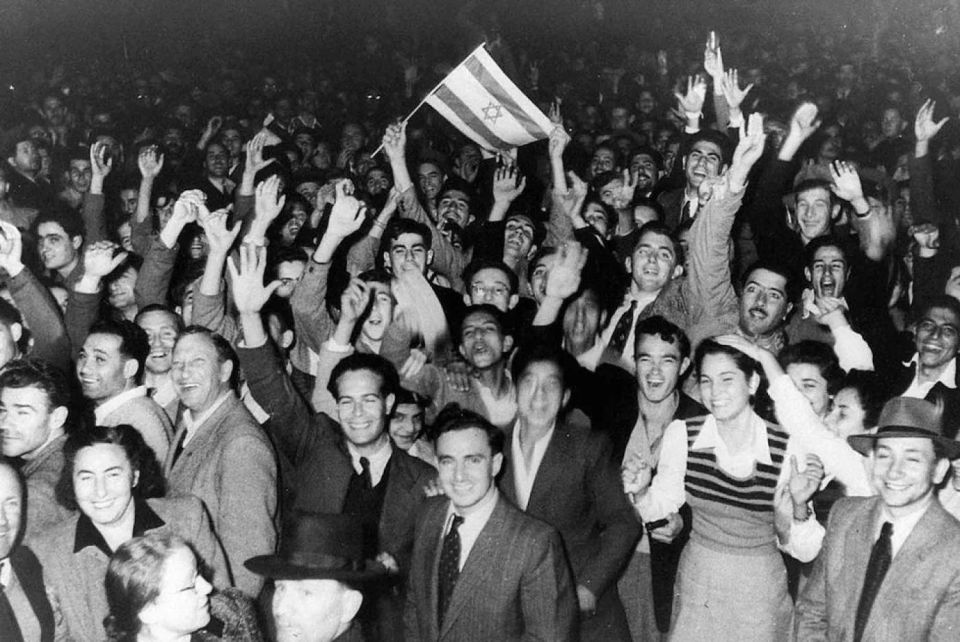
As I’ve engaged in Jewish discourse over Palestine/Israel, I’ve come to notice a distinctly recurrent phenomenon: the reluctance among many to actually define Zionism because the term "means different things to different people.” According to this point of view, when we spend too much time arguing over the word, we get bogged down in semantic arguments when we should be debating the more fundamental issues at hand.
I’m alternately annoyed and fascinated by this claim: annoyed because I think it too often serves as a method to avoid discussing inconvenient truths about Zionism, and fascinated because even now - even as as Israel’s crimes have become so clear and undeniable to the world - there are those who still feel compelled to identify with its underlying ideology.
Yes, it is technically true that there have historically been many forms of Zionism. But since the founding of the state of Israel in 1948, they all share the same basic definition and the same basic goal: the maintenance of a political Jewish nation-state in historic Palestine.
Today, however, the word Zionism has become a kind of catch-all for any number of vague claims, from Israel's "right to exist" to the Jewish people's inalienable right to a political nation in "their land." Intra-communally it has become a kind of litmus test used to gauge ones' Jewish loyalty to the Jewish people. In the wider world, many Zionists will claim that Zionism is synonymous with Judaism itself, seeking to equate anti-Zionism firmly with antisemitism.
Given this ideological reality, it's understandable that many Jews are loathe to define Zionism - because if they actually did so, they would have to seriously consider breaking with it. So-called "liberal Zionism" provides the perfect case in point. The term was coined in the years following the 1967 war, referring to those who opposed Israel's military occupation of the West Bank and supported a two-state solution. It gained in currency after the establishment of the Israeli movement Peace Now in the late 1970s and even more during the Oslo years of the 1990s. In the US, the standard bearer of liberal Zionism is the American organization J Street, whose slogan is “Pro-Peace, Pro–Democracy.”
To be a liberal Zionist, however, one must studiously avoid the ethical problem at the core of Zionism itself: i.e. the concept of a ethno nation-state that depends on a Jewish majority in the land. Before 1948, Jews constituted 32-33% of the population and owned only 8% of historic Palestine. Israel’s very existence as a Jewish-majority state was only made possible by the Nakba: the forced dispossession of more than 750,000 Palestinians from their homes. Since then, Israel has only been able to maintain its majority (what liberal Zionists would call “the Jewish character of the state”) by resorting to increasingly oppressive forms of demographic engineering such as ethnic cleansing, home demolitions, land expropriation, revocation of residency and citizenship rights - and most recently, outright genocide.
Liberal Zionism has always been plagued by this internal contradiction: Israel can be Jewish or it can be democratic, but it cannot be both. Though liberal Zionists still remain fervently devoted to the two-state solution, it's a political formation that's dependent on the decidedly illiberal concept of ethnic segregation, and that still relies on a Jewish majority for its Jewish "character." Tellingly, until relatively recently, it was not unusual for liberal Zionists to advocate for a two-state solution with the patently racist claim that the birth rate of Palestinians posed a "demographic threat" to the Jewish character of the state.
In the age of genocide, this contradiction has never been more obvious and the slogan "Jewish and democratic" has never rung more hollow. Indeed, it’s not difficult to detect an increasing note of desperation in the arguments of those who cling to liberal Zionist fantasies amidst Israel's widening murderous onslaughts. As journalist David Kilon unsparingly wrote in his 2024 article “The Failure of Liberal Zionism:”
If there is one lesson to be taken from the past dismal year, it’s this: the liberal Zionist interpretation of the conflict has no predictive value, no analytical weight, and no moral rigor. It is a failed dream of the previous century, and it is unlikely to survive this one.
There are also those who maintain their Zionist identities by claiming that the core of Zionism is not Jewish political sovereignty but rather a collective connection to a “Jewish homeland.” The most prominent example of this approach is the Zionism of Peter Beinart who, though he has publicly broken with the concept of Jewish statehood, still identifies as a Zionist.
As he wrote in his 2020 NY Times op-ed “Why I No Longer Believe in a Jewish State:”
A Jewish state has become the dominant form of Zionism. But it is not the essence of Zionism. The essence of Zionism is a Jewish home in the land of Israel, a thriving Jewish society that can provide refuge and rejuvenation for Jews across the world.
The kind of Zionism Beinart describes here is inspired by the cultural Zionism of Ahad Ha’am, the Eastern European Zionist writer who opposed Jewish statism in favor of creating a cultural center for world Jewry in Palestine. This approach was later exemplified politically by Brit Shalom, a Zionist organization that advocated for a binational Arab-Jewish state associated with Reform rabbi Judah Magnes, historian Hannah Arendt and philosopher Martin Buber during the end of the British Mandate period.
In May 1948, Arendt made a powerful plea for shared statehood vision on the eve of Israel’s establishment with her essay: “To Save the Jewish Homeland: There is Still Time,” presciently predicting that in a politically sovereign Jewish state, “(the) growth of a Jewish culture would cease to be the concern of the whole people; social experiments would have to be discarded as impractical luxuries; political thought would center around military strategy; economic development would be determined exclusively by the needs of war.”
Despite Arendt’s powerful case however, a shared Arab-Jewish homeland was never a realistic possibility. Brit Shalom was always a tiny minority in a Zionist ecosystem dominated by the political designs of the movement founded by Theodor Herzl, and later realized by Chaim Weitzmann and David Ben-Gurion. To put it plainly, those who continue to identify with cultural Zionism and Brit Shalom today are clinging to an ideology that never actually gained traction - and represented a Zionist road decidedly not taken.
As I consider the claims of present-day cultural Zionists, it often feels like they’re chasing after ghosts, attempting to somehow will this long lost historical movement back into existence. I definitely sensed this attitude from Beinart when I read these wistful words from his recent book, Being Jewish After the Destruction of Gaza:
I wish leftist activists more often acknowledged that there’s a tradition of cultural Zionism, championed in the mid-twentieth century by figures like Martin Buber and Judah Magnes, which wanted a thriving Jewish culture in Palestine-Israel but opposed a Jewish state. (p. 92)
To be honest, I don't think this tradition would be particularly impactful on the attitudes of leftist activists. In the world of solidarity activism, Zionism is defined by what Zionism is - not by what might have been.
Indeed, since the establishment of the state, political Zionism has succeeded in becoming a structural reality embodied by the state of Israel itself, which is the only form of Zionism that has a real impact on real lives in the real world. It is also defined by Zionist institutions that predated the establishment of the state, such as the World Zionist Organization, the Jewish Agency, and the Jewish National Fund, that now exist to support its continued existence as a Jewish polity. In short, this political infrastructure is the Zionist reality. I honestly don’t know how one can identify as a cultural Zionist yet somehow remain aloof from it.
To be sure, trying to separate culture from politics is generally a losing gambit. Consider this example: if there’s one institution that embodies the aspirations of cultural Zionism, it's Hebrew University. Founded in 1818 and established in 1925, the creation of a modern university in Jerusalem symbolized the institutional realization of Ahad Ha’am’s dream for a Jewish cultural revival. Notably, Judah Magnes served as its first chancellor, Albert Einstein (a prominent supporter of Brit Shalom) was its co-founder and Martin Buber was on its original board of governors.
Today, however, like most Israeli universities, Hebrew University has become deeply enmeshed with Israeli statehood - and more crucially, with Israel’s war machine. Hebrew U has long served as the host campus for elite military training programs such as Talpiot (described as the “jewel in the crown of the Israel Defense Forces”) and Havatzalot (which produces “highly skilled intelligence officers for key roles in Israel’s Military Intelligence Directorate”). It also provides support for active-duty soldiers and conducts research to develop new military technologies. In other words, cultural Zionism - a non-statist ideology that would be considered anti-Zionist today - has been subsumed into a highly militarized Jewish nation-state.
No, Zionism is not a concept that can be salvaged by unsustainable contradictions or nostalgia for Zionist ideas that are no longer politically relevant. In the end, this debate isn’t a semantic one - it’s an ethical one. Consciously or not, the claim that “Zionism means different things to different people” only serves to obscure the patently immoral nature of a ethno-nationalist ideology that continues to immiserate an entire people whose crime is its mere existence.
We can ill afford to dither on this point. It’s time for the Jewish community to morally reckon with what Zionism actually is - and to break with it once and for all.
Member discussion