The Nakba Continues to Unfold Before Us
The Zionist narrative of Israel’s birth was a central part of my Jewish education, right alongside the Torah, Jewish prayer, holidays and ritual observance. In its way it was taught to me as a kind of “sacred” and “redemptive” narrative. This is how it went, in short: because the Palestinians – and surrounding Arab nations – were implacably opposed to any Jewish presence in the land, they rejected the very fair 1947 UN Partition Plan and violently attacked Jewish communities throughout Mandate Palestine. Though Zionist leaders desperately urged Palestinians to stay, Arab leaders warned them to flee lest they be massacred by Zionist militias. When “the Arabs” attacked, they were miraculously defeated by the underdog, upstart army of the nascent state of Israel.
As with all sacred narratives, it was considered a sacrilege to question it. To suggest that Israel was established any other way was to promote a “false narrative” at best and engage in “libel” at worst. The Nakba – the term coined by Palestinians to describe the “catastrophe” of their ethnic cleansing – was synonymous with slander.
Today, though this narrative has long since been thoroughly disproven by Palestinian testimonies and Israeli historians alike, Nakba denial has remained as a tenaciously indelible aspect of Israeli social/political culture. As journalist Dahlia Scheinlin observed in 2020, “Over the years, Israel did not move away from denial and toward recognition. Instead, Israeli denialism went from forgetting and erasing the Nakba in the early decades of its existence, to an open and public crusade against any mention of it during the 2000s.” In 2011, Nakba denial officially became part of Israeli political culture when the Knesset passed the “Nakba Law,” making it illegal to engage in Nakba commemoration at a public institution.
Since October 2023 however, prominent Israeli politicians seeking to stoke war fervor over the genocide in Gaza have developed a new trope: i.e., calling for a “second Nakba.” In November 2023, Minister of Agriculture Avi Dichter said in an interview, “From an operational point of view, there is no way to wage a war – as the Israeli army seeks to do in Gaza – with masses between the tanks and the solders…Gaza Nakba 2023 – that’s how it’ll end.” Member of Parliament Ariel Kallner of the Likud party put it this way: “Right now, one goal: Nakba! A Nakba that will overshadow the Nakba of 1948.”
Some might view these kinds of comments as political rhetoric – and to a certain extent they are. In this moment of genocide, these politicians are taunting the Palestinian people by turning their own sacred language back against them. On a deeper level, however, this language makes clear what Palestinians have been telling the world for decades: that the Nakba isn’t over and has in fact been ongoing since 1948. The genocide in Gaza is only the latest – and most blatantly overt manifestation – of an ethnic cleansing project that seeks to establish a Jewish majority state in historic Palestine.
Regardless of the words they use, the leaders of Israel are making their intentions all too clear through their actions. In 2024, only a few months after the start of Israel’s genocide, journalist Meron Rappaport put it aptly in an article entitled “The Second Nakba Government Seizes it’s Moment:”
The Israeli army’s declared goal in Gaza is to incapacitate Hamas and other Palestinian armed groups. Its actions over the past three months, however, attest to a far broader campaign resembling policies of Nakba: expelling civilians en masse and rendering their homes and neighborhoods uninhabitable.
Around the same time, the board of my congregation, Tzedek Chicago, reached a similar conclusion in our statement, “In Gaza, Israel is Revealing the True Face of Zionism:”
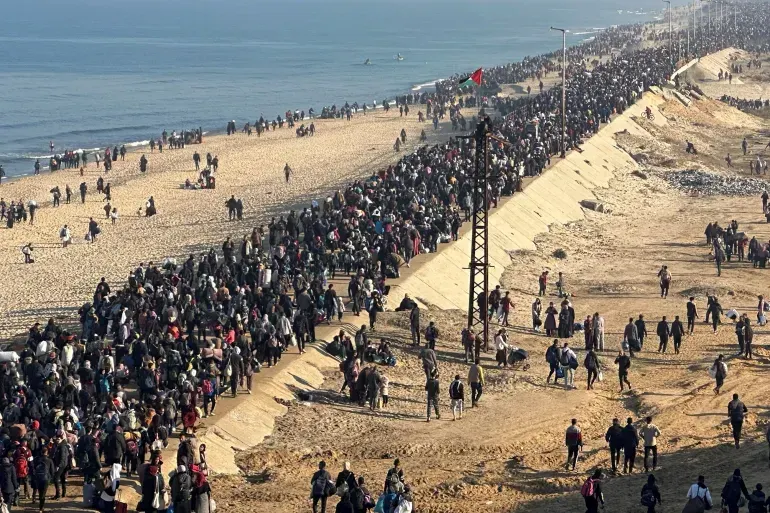
Israeli leaders are being true to their word: we are witnessing the continuation of the Nakba in real time. As in 1948, Palestinians are being driven from their homes through force of arms. As in 1948, families are being forced to march long distances with hastily-collected possessions on their backs. As in 1948, entire regions are being razed to the ground, ensuring that they will have no homes to return to. As in 1948, Israel is actively engineering the wholesale transfer of an entire population of people.
With the genocide now approaching its third anniversary, this latest chapter of the Nakba is now entering a chilling new phase. Using military technology that could scarcely be imagined in 1948, Israel has reduced most of Gaza to a moonscape - and is proceeding to squeeze the Palestinian population of 2,000,000 into smaller and smaller enclaves. This strategy mirrors the actual creation of the Gaza Strip in 1948, when it became a repository for a flood of Palestinian refugees from cities and villages in the coastal plain and lower Galilee. Before the Nakba, the residential population of this small region numbered 60 to 80,000. By the end of the hostilities, at least 200,000 refugees were crowded into what came to be called the Gaza Strip. Its borders were drawn arbitrarily, determined by the position of Egyptian and Israeli forces when the ceasefire was announced. It ended up being smaller by at least a third than the entire area of the Gaza District during the Mandate period.
At the time, most of the refugees fully expected to return home – some could even see their towns and villages through the fences. Those who crossed the border to gather their possessions or harvest their crops were considered “infiltrators” by Israel and shot on sight. Eventually, it became all too clear there would be no return. Over the years the tents turned into concrete buildings that grew ever higher in that narrow corridor. The numbers of that once sparse territory eventually grew to a population of over 2,000,000 people.
Now flash forward to last October: as part of the so-called “ceasefire deal” between Israel and Hamas, Gaza was divided into two north-south zones divided by a “yellow line.” The eastern side of the line, which comprises roughly 60% of the Gaza strip, is under the control of the Israeli military. (It also includes most of the agricultural land used by Palestinians in Gaza before the genocide.)
Meanwhile, the people of Gaza have been forcibly displaced into the narrow western part of the strip, though many of them have (or had) homes on the other side of the line. As a result, this narrow strip of land – which was already one of the most densely populated places on earth - has been narrowed yet further. As in 1948, refugees whose very existence poses an inconvenience to Israel are being crowded into an arbitrarily drawn territory. As in 1948, Palestinians who cross the line to visit their homes – or even approach the line itself – are being shot on sight.
And as in 1948, formerly temporary borders have a way of becoming permanent. Last week, Drop Site News cited an analysis by Forensic Architecture that concluded Israel has built more than 25 kilometers of earthen barriers inside Gaza since the “ceasefire,” physically dividing Gaza along the line of Israeli control as it corrals Palestinians into less than half of the strip:
President Donald Trump’s “Board of Peace” has unilaterally rewritten the Gaza ceasefire agreement, resistance leaders recently told Drop Site, in an effort to compel Palestinians to surrender their liberation cause and institutionalize Israeli domination over the future of the Gaza Strip. Israel and the US have been trying to implement terms that Hamas never agreed to—specifically, disarming the resistance while Israeli forces continue to occupy most of Gaza and violate the ceasefire on a daily basis. Since October, more than 900 Palestinians have been killed in Gaza in Israeli airstrikes and shootings, many of them targeted close to the “yellow line.”
If Israel’s actions aren’t making it clear enough, Netanyahu said the silent part out lout last week during a conference in the West Bank: “We are now in 60% of the territory of the Gaza Strip. We were at 50%. We moved to 60%,” he said. “My directive is to move to — take it step by step — first of all 70. Let’s start with that.”
When you combine that statement with one he made in December 2023: that he is actively seeking the ethnic transfer of Palestinian from Gaza and the only problem is "who will take them" - the rest is commentary. Bottom line: the Nakba continues to unfold before us. We cannot say we weren't told - and we can never say we didn't know.
As I continue stand down the Zionist narrative taught to me by the Jewish community and construct a new one to take its place, it has occurred to me that none of the terms we employ – i.e., colonialism, apartheid, genocide – fully capture the reality of this persecution as well as the word Nakba. In the final analysis, the use of this term ultimately gives Palestinians the agency to narrate the truth of their oppression and to define it according to their own experience.
In 2024, Palestinian legal scholar Rabea Eghbariah wrote an important article for the Columbia Law Review entitled, “Toward Nakba as a Legal Concept.” In his paper, Eghbariah powerfully analyzed the anatomy of the ongoing Nakba and argued that the term deserved to be understood according its own legal framework.
The Harvard Law Review had refused to publish a similar, shorter version of the article it had solicited from Eghbariah even after it was initially accepted, fully edited and fact-checked. After the Columbia Law Review published the paper, its board of directors pulled it by shutting down its own website. It was subsequently reinstated after the student board went on strike.
Of course, this kind of draconian censorship only proves the essential point that Nakba is about ongoing erasure. And further, that it will only be overcome through the ongoing struggle for justice – and the knowledge that justice is indeed possible.
As Eghbariah himself wrote in his paper:
The international community has a responsibility to dismantle the ongoing Nakba that twentieth-century colonialism has constructed in Palestine. Zionism—only one modality of Jewish existence in Palestine—is conditioned upon the subjugation of the Palestinian people. There is a long and rich history of Jewish existence in Palestine that is not premised on systemic violence, domination, and ethnonational supremacy. Drawing from this tradition may provide inspiration, even though Zionism and its ultimate manifestation in the ongoing Nakba have ruptured and restructured reality in myriad ways that hinder our ability to imagine such futures. But once the Nakba is centered and recognized, it becomes easier to articulate a vision of freedom and dignity for all people concerned. Justice is not naivety, and the reality of ongoing Nakba is not inevitable.
.
Member discussion