Jewish Anti-Zionism: It's Time to Say it Out Loud
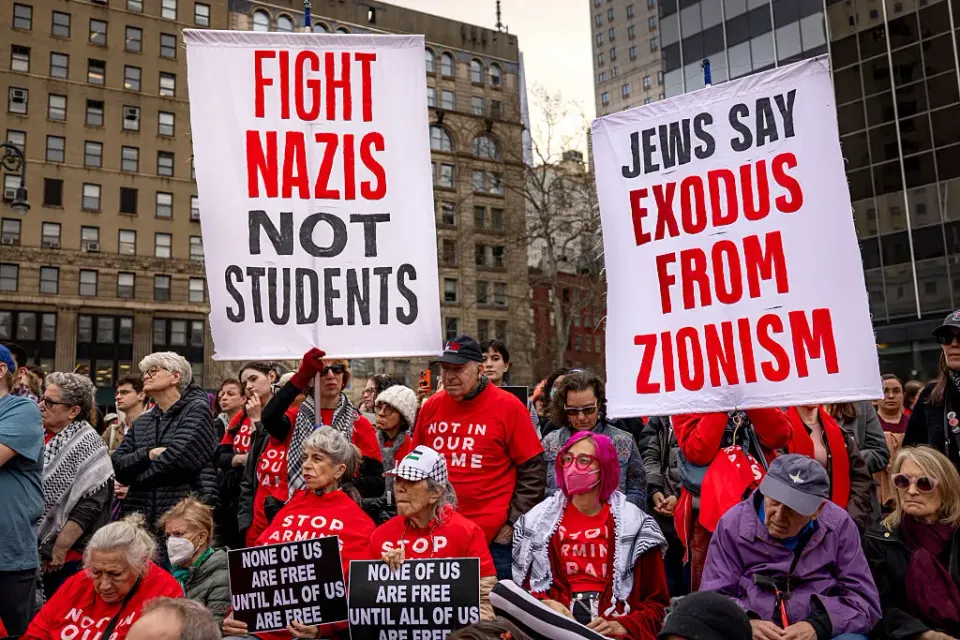
Jewish and Anti-Zionist. It’s time to use those words together and to say them out loud.
A story: in 2022, my synagogue, Tzedek Chicago, made the decision to collectively affirm anti-Zionism as a congregational value. Technically speaking, this meant changing a specific passage in our Core Values Statement:
While we appreciate the important role of the land of Israel in Jewish tradition, liturgy and identity, we do not celebrate the fusing of Judaism with political nationalism. We are non-Zionist, openly acknowledging that the creation of an ethnic Jewish nation state in historic Palestine resulted in an injustice against the Palestinian people – an injustice that continues to this day.
When we founded Tzedek Chicago in 2015, we used the word “non-Zionist” to describe ourselves because at the time the term “anti-Zionist” just felt like too stark a line to take. Over the next few years, however, increasing numbers of Jews, particularly young Jews, were openly describing themselves as anti-Zionist. As political scientist Dov Waxman pointed out, “For many, their problem with Israel is not just its current prime minister, its government’s policies and its nearly 51-year-long occupation of the West Bank. It is also Israel itself that they are uncomfortable with, specifically its identity as a Jewish state.” A particularly significant milestone occurred in 2019 when Jewish Voice for Peace, following a long organizational discernment process, officially identified as anti-Zionist. As JVP explained in a released statement, “Jewish Voice for Peace is guided by a vision of justice, equality and freedom for all people. We unequivocally oppose Zionism because it is counter to those ideals.”
Likewise, when the Tzedek Chicago board voted unanimously in 2022 to change the word (actually, the half-word) in our Core Values from “non-Zionist” to “anti-Zionist,” it was far more than a semantic adjustment. Our own values statement defined Zionism as an ideology that “resulted in an injustice against the Palestinian people – an injustice that continues to this day.” In the end our leaders decided, it didn’t make moral sense to take a neutral position on an ideology of injustice and Jewish supremacy. As Angela Davis famously taught, “in a racist society, it is not enough to non-racist, we must be anti-racist.”
Since the board didn’t want to make such a significant change to our Core Values by fiat, however, it decided to organize facilitated congregational conversations on the issue and eventually put it to a membership vote. During our discussions, it was clear that almost everyone welcomed the change in theory. Still, some important questions were raised. Some members wondered if such a change would only further marginalize us from the “Jewish community.” Others noted that the word “anti-Zionist” was a term that overly centered Zionism. Still others pointed out that the word expressed what we opposed, but not what we were advocating for.
In the end, 73% of the membership quorum voted to make the change. In a statement announcing the decision, the board explained:
Given the reality of (Zionism’s) historic and ongoing injustice, we have concluded that it is not enough to describe ourselves as “non-Zionist.” We believe this neutral term fails to honor the central anti-racist premise that structures of oppression cannot be simply ignored - on the contrary, they must be transformed...
While Jewish anti-Zionists are still a minority in the Jewish community today, their numbers have been increasing, particularly among those under 30 years of age. Not coincidentally, we are witnessing increasingly vociferous calls from the Israeli government, Israel advocates and Jewish institutions to label anti-Zionism as antisemitism. There have also been public calls to categorize anti-Zionist Jews as “Un-Jews” and “Jews in name only.” Given the tenor of the current moment, we believe the need for public stances by principled Jewish anti-Zionists is all the more critical.
We believe the core value of anti-Zionism will open up many important opportunities for our community. It will guide us in the programs we develop, the Jewish spiritual life we create, the coalitions we join and the public positions we take. In a larger sense, we believe this decision will create space for other Jewish congregations to take a similar stand - to join us in imagining and building a Jewish future beyond Zionism.
Anti-Zionist Judaism continues to become undeniable aspect of American Jewish life. Since the onset of Israel’s genocide in Gaza in particular, there has been a steady growth in anti-Zionist synagogues, ritual spaces and educational initiatives across North America. Shel Mala, a “digital first queer yeshiva,” describes itself as “normatively anti zionist.” In New York City, Jewish Liberation Learning, a children’s learning program for pre-K to 7th graders, proclaims unabashedly, “We are building the Judaism that will outlive Zionism.” Makom, a congregation in North Carolina, says in its values statement:
We seek to live into a Judaism that upholds the liberation of all people. We are anti-Zionist, which means we support Palestinian self-determination and refuse to let our Judaism be a moral cover for apartheid. We belong to a growing number of Jewish communities that do not materially, politically, or spiritually support Israel’s colonization of Palestine or the ongoing oppression of the Palestinian people.
And from Beyt Tikkun, a synagogue in the San Francisco Bay Area:
We reject zionism’s violent, settler-colonial project that enforces white Jewish supremacy, systematically displaces Palestinians, enshrines apartheid, and drives the ongoing genocide in Gaza. Zionism is not only a political and nationalist ideology—it is a continuing system of colonization, ethnic cleansing, and structural oppression, fully reinforced by U.S. economic and military power. It is fundamentally incompatible with the core Jewish values of equality, compassion, and care.
In addition to these emergent anti-Zionist spaces, a new generation is rediscovering and lifting up the venerable history of Jewish anti-Zionism as a sacred lineage. Molly Crabapple’s new book on the Jewish Bund, “Here Where We Live is Our Country,” which debuted at #4 on the New York Times bestseller list, received a rapturous review from that paper with the headline, “What Does Judaism Look Like Without Zionism?” The past year also occasioned the publication of historian Benjamin Balthaser’s book “Citizens of the Whole World: Anti-Zionism and the Cultures of the American Left” as well as journalist Benjamin Moser’s, “Anti-Zionism: A Jewish History.” A new 400-page reader, “Jewish Anti-Zionism: A Historical Anthology” is slated for publication this November.
Over the past few years, I’ve spoken to plenty of Jews who oppose Zionism, yet continue to find it uncomfortable referring to themselves as “anti-Zionist.” It’s a sign of how central Zionism has become to Judaism and Jewishness that it such a term can still feel downright heretical for those who are otherwise anti-Zionist. In traditional Judaism, there is a term known as “kofer ba’ikar,” which means “one who breaks the central principle.” In the Talmud, the exemplar of this concept was the disgraced theological heretic, Rabbi Elisha Ben Abuyah. Today, Zionism itself has been the ikar – the central principle – and there still many Jews who feel like contemporary Elishas if they position themselves against it.
Yes, the term anti-Zionist centers Zionism - that's because Zionism is an ideology that remains hegemonic in Jewish life. To those who reject the term because it is inherently negative, I would emphasize that anti-Zionism is not and should not be an all-encompassing descriptor of a Jewish identity. In the end, anti-Zionist Judaism is part of a larger liberative Jewish ethos that views solidarity with the oppressed as a sacred imperative, that seeks to build a world free of colonial and imperial domination, guided by the spiritual teaching that all humanity is created b’tzelem elohim, in the image of God.
Anti-Zionist Judaism is also rooted in a vision that seeks to recenter the diaspora – not a Jewish ethno-state – as the living locus of Jewish life. In 2016, for my second Rosh Hashanah sermon at Tzedek Chicago, I described this approach to Judaism as a “New Jewish Diasporism”:
Right now, the Jewish population of the world is split almost in half between Israel and the Diaspora. Where does this leave those in the Diaspora who choose not to center our Judaism around Zionism, who refuse to celebrate a Judaism of isolation from the rest of the world? Is there a place for those who want to celebrate the Diaspora as dynamic and fertile ground for a new kind of Judaism? One that embraces our existence among diverse nations? One that advocates for the universal redemption of all peoples?
In its 2022 statement, the Tzedek Chicago board put it this way, in a sense, answering the questions I had posed six years earlier:
At Tzedek Chicago we seek to develop and celebrate a diasporic consciousness that joyfully views the entire world as our homeland. Moving away from a Judaism that looks to Israel as its fully realized home releases us into rich imaginings of what the World to Come might look like, where it might be, and how we might go about inhabiting it now. This creative windfall can infuse our communal practices, rituals, and liturgy. We also believe that Jewish diasporic consciousness has the real potential to help us reach a deeper solidarity with those who have been historically colonized and oppressed.
The launching of the Jewish Diaspora Movement last week is an exciting indication that this “Jewish diasporic consciousness” has now begun to grow institutionally. According to its own self-description, the JDM “is a constellation of communities, projects, and leaders who embrace life affirming, vibrant, diverse expression of Jewishness and a commitment to all peoples’ and peoples’ liberation. We aspire to be a hub for Jewish cultural and religious projects that reject the assumption that Jews need an insular culture or a militarized ethno-state.”
The JDM currently has 47 member organizations that are part of its “founding minyan,” and I have no doubt that the number of affiliated groups will surely increase over the coming months and years. At its core, the movement is an effort to intervene in hegemony of Jewish legacy institutions that “are actively causing harm by aligning with oppressive state power, funding Israel (and therefore the ethnic cleansing and genocide of Palestinians), conflating antizionism with antisemitism, and refusing to engage in meaningful dialogue with dissenters.”
I’m proud that Tzedek Chicago was one of the first groups to join the JDM’s founding minyan and am very encouraged there is now an anti-Zionist-normative framework for this growing Jewish ecosystem. I strongly believe that our collective vision must seek to build real power if it is to have impact. As Arielle Angel wrote in her incisive Jewish Currents article last year:
We need new Jewish institutions. We need them to carry our politics, and also the other facets of our lives. We need them to discover who we are, and to put this discovery to use in the world. We need them not to exit Jewish community, but to join it in earnest, on our own terms. To transition from pockets of rebellion to poles of power.
I cannot agree more. Those of us who are seeking to build a new anti-Zionist Judaism will not do it via appeal to the existing Jewish community, nor through a Judaism that is content to be marginal and dissident to “mainstream” Jewish life. We will only do it by creating a new and beautiful Jewish hegemony that centers the liberation of all above all.
If that sounds daunting and even messianic, I don’t disagree. But for those who yearn for a Judaism beyond militarism, occupation and genocide, there is no other way.
Member discussion