The New Yorker Reports on the Jewish American Divide
A number of people have asked me for my opinion on Eyal Press' eleven-page article The New Yorker article, "The Divide: At Synagogues, Arguments About Israel are Boiling Over." My short answer: I have lots of complicated thoughts about it. Here's my attempt at a longer response:
In his piece, Press explores how "disagreements about Gaza and Zionism have divided (Jewish) congregations" by training a microscope on the experience of Congregation Beth El, a Conservative synagogue in South Orange New Jersey. He bookends the article with the story of one congregational member: Nathaniel Felder, who became upset when, a year after October 7 (while Israel's starvation of Gazans was in full swing), Beth El displayed a sign in front of its building that read "We Stand With Israel and We Pray for Peace." Felder complained to the congregation's rabbis but was told that while they understood his upset, the sign would remain. In response, he stood in front of the synagogue with his own sign: "Starvation Is Against Jewish Values: Our Support of Israel Cannot Be Unconditional" - causing inevitable upheaval among the congregational membership.
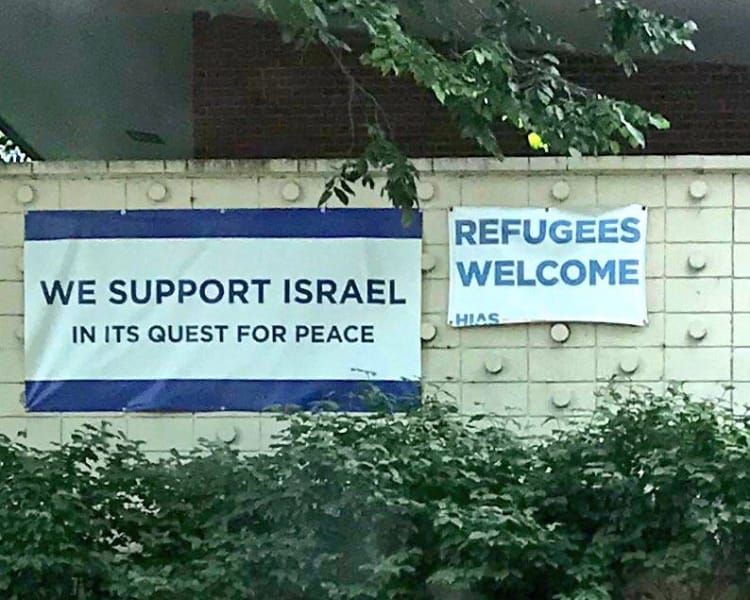
Felder astutely commented on the "disjuncture" he felt when he heard that the Beth El rabbis planned to lead a Jewish solidarity service outside an ICE detention facility: "For me, we had lost the moral authority to advocate for social justice at that ICE facility by ignoring the mass starvation of a civilian population. It made the ICE protest hollow." (To my mind, the photo at the top of this post illuminates this moral pretzel logic perfectly. While I don't know the synagogue where it was taken, the juxtaposition of the two banners exposes the almost comically ironic contradiction at the heart of so-called "liberal Zionism.")
Press also reported on the experience of another upset congregant, Liba Beyer, who organized informal, unofficial gatherings for Beth El members feeling "shame about the escalating civilian death toll in Gaza." These efforts resulted in the creation and growth of a Whats App group "that allowed congregants to engage in critical dialogue about Israel and to post messages about events of shared interest, such as local vigils calling for a ceasefire in Gaza." Press notes that Beyer, who described herself as an anti-Zionist, reflected the views of increasing numbers of younger Jews in the community. "Who," Beyer comments, "do the rabbis think are going to be their congregants in eight, nine, ten years?"
According to the article, Beth El's leaders and members made several attempts to widen the congregational tent on the issue of Palestine/Israel, including an event entitled 'Wading Into The Gray: Understanding and Disentangling Antisemitism and Anti-Zionism." (It didn't end well.) In a High Holiday sermon, Beth El's Rabbi Jesse Olitsky tried to thread the needle this way: "Saying 'I Stand With Israel' means 'I believe in Israel, what Israel is, what Israel can be - the Israel I dream of.'" ("So much for Big Tent Judaism," Felder reported thinking as he drove home from the service.)
Press' widens his lens with comments from other rabbis and Jewish leaders who have expressed sadness and alarm over the growing American Jewish divide. In her High Holiday sermon, Central Synagogue's Rabbi Angela Buchdal remarked that this fault line represents "the most painful experience of (her) rabbinic life." Prominent Los Angeles rabbi Sharon Brous "felt stung" after being slammed for expressing sympathy for Israelis and Palestinians in "absolute balance." And Nomi Colton-Max, a former president of Beth El, ruefully admitted, "we allowed the tent to go further to the right but never to the left."
It bears noting, however, that Colton-Max serves as the vice-president of the American Zionist Movement. And therein lies the fundamental contradiction of the big tent model: the terms are still being determined by Zionist leaders, in congregations that are still default Zionist. In the end, the big tent concept represents an attempt to paper over the unbridgeable chasm between Zionists and anti-Zionists under the guise of "inclusion."
I addressed this very issue directly, in a 2023 article for Truthout:
Is this so-called open tent ultimately tenable? Is it sustainable? Is it even ethical to build congregational communities in which members have such fundamentally different moral approaches to being Jewish? In which some congregational members cherish and celebrate an ethno-nationalist Jewish project, while others rightly call it out as an apartheid, settler colonial state?
Too often, liberal Jewish congregations wield the word “inclusion” to provide them with convenient cover for avoiding the painful choice on Israel’s structural oppression of the Palestinian people. But in the face of Israel’s merciless assault on Gaza, this equivocation now rings more pitifully hollow than ever — accentuating all the more the extent to which Zionism has presented the Jewish community with an untenable, unbridgeable divide.
It feels perversely obvious to say so, but I'll go ahead and say it: it is ethically impossible to create community with those who support or equivocate on genocide and those who find it morally abhorrent. There is absolutely no viable "big tent" to be made on this issue, nor should there be. Jews of all people should know that a time of genocide is not a time for erecting big tents. It is a moment of truth - a time to make a fundamental ethical determination over which side we are on.
Indeed, Beth El's experience seems to indicate that this divide is ultimately unbridgeable. Press reports that the synagogue did indeed eventually take down their "We Stand With Israel" banner. After the last Israeli hostage had finally been released, synagogue leaders replaced the divisive sign with a simple Israeli flag. (As Nathaniel Felder would say, "So much for Big Tent Judaism.")
In the end, Press' conclusions aren't really that surprising or novel. Jewish communal surveys have consistently indicated a growing divide over the issue of Israel and Zionism well before October 7, 2023. It's already been widely reported that this gulf has accelerated during the course of Israel's genocide in Gaza - and that we're currently witnessing the burgeoning of a Jewish movement for a Judaism beyond Zionism growing outside of the Jewish communal establishment.
Press' reportage, expert as it is, is limited by his choice to comment on American Jewish attitudes through a narrow focus on one congregation. By all reports, we're well past the "Golden Age" of American Jewish congregational life. A 2020 Pew survey revealed that a distinct minority of American Jews, 36%, were affiliated with congregations. It also found that synagogue membership peaked at 43% among households with annual incomes of $200,000 or more, while only 25% of those with lower household incomes belonged to congregations.
Press' article may tell us a great deal about the shrinking subset of American Jews who belong to affluent suburban congregations, but it's not an accurate reflection of the entire Jewish community - which includes a significant percentage of American Jews who resist affiliation with synagogues for a variety of reasons, not least of which is their unconditional insistence on "standing with Israel." A more accurate report on the growing American Jewish divide would do well to focus on the dramatic growth of anti-Zionist Jewish organization Jewish Voice for Peace, the significant and growing presence of Jewish activists in the Palestine Solidarity movement, the massive Jewish-organized protests around the US and the myriad of Passover seders held on college student encampments.
In the end - and on a deeper, more visceral level - Press' focus on the woes of Congregation Beth El left me with a distinctly queasy feeling. While I understand The New Yorker has its demographic, it feels more than a little unseemly, as Israel's ongoing genocide continues to murder journalists and children, its military decimates South Lebanon and bombards Iranian civilians with air strikes, to train its spotlight on how Israel's actions are causing angst for upscale American Jews.
Perhaps this fruitless attempt to create consensus over Israel signifies the final desperate attempt to save our morally broken community. No, we don't need a big tent. We need, as Jewish Currents editor Arielle Angel so aptly put it, new Jewish institutions. I have no illusions that The New Yorker will report on this phenomenon any time soon, but when it does, we'll definitely know that a new Jewish era - one that openly promotes a Judaism beyond Zionism - will have finally arrived.
Member discussion