An Eyewitness Lamentation for the People of Gaza
On the eve of the Jewish fast day of Tisha B'Av, it's traditional to hear the chanting of the Biblical book of Lamentations to usher in the festival. For those who listen carefully to the words being chanted, it's a raw and almost unbearable book, describing the Babylonian destruction of Jerusalem in horrific detail. If there were ever a trigger warning for a book in the Bible, it would be this one:
Arise, cry out in the night
At the beginning of the watches,
Pour out your heart like water
In the presence of the Sovereign!
Lift up your hands
For the life of your infants,
Who faint for hunger
At every street corner.
See, O God, and behold,
to whom You have done this!
Alas, women eat their own fruit,
their newborn children!
Alas, priest and prophet are slain
In the Sanctuary of the Sovereign!
(Lamentations 2:19-20)
Lamentations is a literary howl of grief - and in the traditional Jewish understanding, we chant it on Tisha B'Av not only for the destruction of Jerusalem by the Babylonians and again by the Romans centuries later, but for a litany of tragedies and losses that have befallen the Jewish people throughout our history. It's not an easy ritual, but it is an essential one: a sacred opportunity to give voice to our individual and collective pain so we may move toward the healing season embodied by the High Holidays.
What does it mean, however, to chant these words in the age of Zionism, when we are approaching the third year anniversary of a genocide perpetrated by a Jewish state? How do we begin to understand the mourning of Tisha B'Av while our sacred script has been flipped? When a Jewish ethno-state are the Babylonians/Romans/Iniquistors/Cossacks/Nazis and it is now the Palestinians who have taken the place of the Jewish people?
I believe the first step is to admit this truth of this tragic reversal: to honestly acknowledge that the fatal fusing of Judaism with colonialism, state violence and militarism has brought us to this terrible point - and that we can no longer continue with our religious rituals pretending that nothing has changed. Once we do this, the grief at the core of Tisha B'Av must be an act of solidarity with the Palestinian people, who are living out the horrors of the book of Lamentations every single day.
Does this mean there can be no room to grieve Jewish trauma and loss? Of course not. But it does mean, as I wrote in an earlier post, that we are in a moment in which Judaism is breaking wide open:
The broken pieces have long been laying scattered before us, whether we’ve chosen to see them or not. The critical question now is how we will move forward. Will we keep on davening our prayers, celebrating our holidays, observing our rituals while we willfully ignore this devastating reality? Or will we accept that our spiritual tradition has become fundamentally broken - and will have to be put back together differently if we are committed to preserving its ethical core?
One aspect of this tikkun - this "putting back together," I believe, is to recognize that we live in a time where the moral hierarchy of grief has fundamentally changed. In this moment, it simply cannot be about us.
To this end, I'd like to suggest that in addition to (or instead of) the chanting of Lamentations, we read aloud eyewitness reports of the sacrilege that Israel continues to inflict on the people of Gaza. It isn't difficult find such accounts in the press - they have been reported unceasingly to us for the past three years. Many of us have been regularly scrolling through them on computers and mobile devices, reading them, struck numb, not sure where to put our shock and grief, then going on with our lives until we read the next account and the horrible cycle starts up all over again.
It occurs to me that every one of these stories is at its core, a sacred story. And that one very real way to honor their sanctity is to read them that context; during a ceremony of grief, mourning and accountability with the admission that it is mipne chataeinu - "because of our sins" as Americans and Jews - that these atrocities continue to occur without cease.
Here, below, is the but one "chapter" of this new book of Lamentations. Like the Biblical book, it's words are beyond unbearable to read. I offer it in the spirit of this day, this season in which we allow grief to penetrate our souls, that it may lead us to a greater resolve to rebuild a world beyond such inhumanity, where dignity, justice and compassion is extended to all.
At 9:30 p.m. on Monday, June 29, families sheltering in tents in the al-Mawasi area of Khan Younis received four phone calls from individuals identifying themselves as officers in the Israeli army. They were ordered to evacuate the area within seven minutes. Others receiving similar calls were told they had 15 minutes to flee.
The warning left almost no time to gather the few possessions families had managed to preserve after months of displacement.
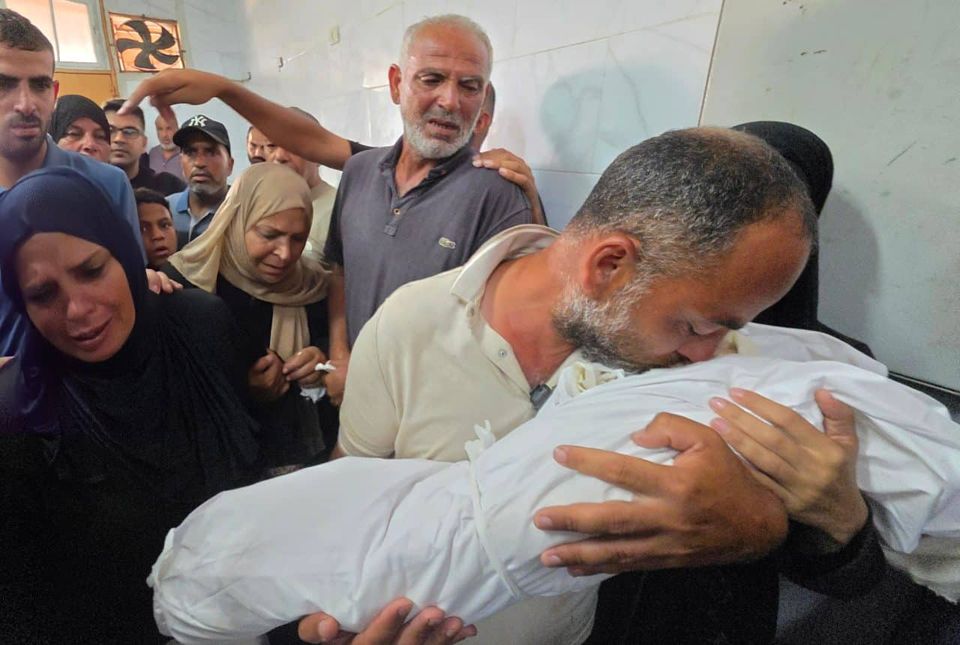
Among those who fled was Diana Abu Daraz, 23, carrying her one-year-old daughter, Siwar.
Siwar had only been days away from celebrating her first birthday. This coming birthday would have marked her first year of life. Instead, her relatives said, she will spend that birthday buried with her mother. They were both killed trying to leave their tent.
“We were told to evacuate,” Diana’s older sister, Yasmeen, told Mondoweiss. “But less than a minute after the warning, the bombings began. My sister was trying to flee, but she couldn’t.”
According to eyewitnesses, Diana was holding her daughter and heading away from the area that had received the evacuation when the bombs fell. She was almost 400 meters away from the site, one eyewitness said, when shrapnel from the bomb that fell in the area struck her from behind as she ran. The shrapnel severed Diana’s body in two and opened a wide gash in her daughter’s head, her brain hanging outside of her skull.
“They tell us these are ‘safe zones,’” Yasmeen said. “But they didn’t even wait for us to leave before bombing them.”
“When the missile hit, no one could see anything,” Saed Abu Daraz, Siwar’s uncle, recalled. “The entire area was engulfed in flames.”
But within moments, he said, chaos gave way to horror. “Suddenly, I saw Siwar lying on the ground beside me while her mother was still holding her. The blast had torn her mother’s body in half, and another piece of shrapnel hit Siwar in the head. Her entire brain was outside her skull.”
For several moments, he said, he was unable to react. “I didn’t know what to do, where to go, or even how to move. What I saw was beyond anything I could bear.”
According to Abu Daraz, Diana and her daughter were exiting their tent and attempting to comply with the evacuation order when they were struck.
“I accept what God has written for me. We will all die, whether today or tomorrow,” said Thaer Abu Daraz, the little girl’s father, in video testimony obtained by Mondoweiss. “But God chose this little girl to be among the martyrs, and He chose her mother to remain with her, so that she would not be alone.”
Those nearby witnessed scenes they say will never leave them.
“Siwar was born, lived, and died during this war,” said Siwar’s grandmother, Wijdan Abu Daraz. “A single piece of shrapnel split my daughter in two and killed my granddaughter. What did either of them do?”
“They have killed everyone we loved,” Wijdan said. “They left no one behind for us.”
(Reported by Tareq S. Hajjaj for Mondoweiss, June 30, 2026)
Member discussion