Redeeming Zion from Zionism
Every now and then I hear from Jewish anti-Zionists who tell me that they're struck by the ubiquitous appearance of the word "Zion" in Jewish liturgy and tradition. They ask: are these specific references to Jewish national sovereignty in historic Palestine? And if not, what should we make of this term?
The short answer to these questions is no, these references were not originally intended to denote what we would refer to today as Zionism. The longer answer, however, is... well, longer.
The word Zion, of course, predates the emergence of the Zionist movement by centuries. The actual term "Zionism" was coined in the 19th century by Nathan Birnbaum, an Austrian journalist and writer who played a prominent role in the early Zionist movement. (Fun fact: Birnbaum later broke with Zionism completely and led a movement for Jewish autonomy in the diaspora. Yes, the person who invented the word Zionism eventually became an anti-Zionist. Make of that what you will...)
Many may also be surprised to learn that the word Zion (in Hebrew, "Tzion") doesn't appear in the Torah at all. It is first mentioned relatively late in the Bible, in 2 Samuel 5:7: "David captured the fortress of Zion, which is the City of David." This verse occurs in the early reign of King David, as he was solidifying the Israelite kingdom through conquest. Zion was originally the name of a Jebusite stronghold on the edge of Jerusalem. It eventually became part of the Israelite capital where David established his kingdom and where the 1st Temple would eventually be built by his son Solomon.
As a Biblical term, Zion eventually came to refer to the city of Jerusalem, to the Temple and sometimes to the land as a whole. Following the destruction of the 1st Temple and the ensuing Babylonian exile, Zion became a symbol of grief, loss and the desire for return - most famously in Psalm 137's lament: "By the waters of Babylon we lay down and wept, as we remembered Zion." The book of Lamentations, which describes the destruction of Jerusalem by the Babylonians, likewise includes references to the "Daughter of Zion" (Bat Tzion), suggesting a mother grieving over the loss of her children.
It's important to note, however, that the yearning for return to Zion in these Biblical dirges did not express a desire for a return to sovereignty and a restoration of the Israelite kingdom. They were, rather, expressions of spiritual isolation from God and a yearning for spiritual return. As Psalm 137 puts it, "How can we sing God's song in a strange land?" Zion embodied an aching for spiritual closeness and proximity to the Divine, who had been enthroned in the now-destroyed Jerusalem Temple. It's also worth noting that the eventual return of a portion of Israelites from Babylon to Zion in 516 BCE did not occasion a return to political sovereignty. Other than a brief, ill-fated period of Jewish independence under the Hasmonean dynasty, the Jewish return to the land was not about restoration to power. Rather, return to Zion was characterized by a restoration of the Jewish people's relationship to God and a reestablishment of the covenant.
It was during this period that Zion became increasingly understood as a future, messianic restoration of the House of David. This vision became particularly prominent after the destruction of the 2nd Temple in 70 CE. Drawing on prophetic verses from the Bible (see, for instance, Isaiah 11:1 and Micah 5:2), Zion became less a reference to the physical city or land, but an aspirational vision of a messianic future when the dead would be resurrected, the Jewish people returned to the land and the Temple rebuilt once again. This messianic vision of restoration at the end of days was referred to in Jewish tradition as kibbutz galuyot: the "ingathering of the exiles."
Many of these messianic references to Zion became staples of traditional Jewish liturgy. The Yotzer Or prayer in the morning service, for instance, ends with the blessing, "Shine a new light on Zion, and may we all be worthy of its glow." The Amidah, the central standing benediction, likewise contains the words: "When will You reign in Zion? Soon, and in our lifetime, may you come to dwell eternally." One of the seven Jewish wedding blessings uses the image of the grieving Bat Tzion rejoicing as her children are reunited in God's messianic kingdom: "May the childless one rejoice greatly in the ingathering of her children within her with joy. Blessed are you, oh God, who brings joy to Zion with her children."
With the expansion of Jews throughout the diaspora, the idea of Zion also became portable, as it were. As the scholar Dr. David Kraemer has pointed out: "Jews through the ages have hoped that one day the Messiah would come, leading them back to Zion. But in the meantime, they lived all over the world, making homes in one diaspora or another. And remarkably, they often spoke of their diaspora homes as 'Zion,' a place of redemption long before actual redemption."
For the majority of Jews who lived throughout the diaspora, the concept of Zion and Jerusalem became a spiritualized symbol. Cities that were centers of robust Jewish life became actually became referred to as “Jerusalems.” In the late 16th and early 17th centuries, for instance, Amsterdam was referred to as the “Jerusalem of the West” following the immigration of Sephardic Jews from Spain and Portugal. Likewise, Vilna was known as the “Jerusalem of Lithuania” and Tlemcen, Algeria was called “Jerusalem of the Maghreb.”
The concept of Zion was further developed in traditional Judaism by the theological assertion that Jerusalem - and specifically the site of the Temple Mount - was the geographical "center of the universe." In the Talmud, Rabbi Jochanan speaks of a "foundation stone" (even she'tiyah) in the ancient Temple upon which the world was based. (JT Yoma 5:3) The medieval Jewish commentator Rashi suggested that the foundation stone was fashioned by God at the outset of creation: "Zion was created first and then clods of material struck around it from every side and continued to do so until they reached the ends of the earth." (Commentary on Pirke Avot 1:2)
This concept is also quite prominent in Jewish mysticism. According the the Zohar, the central text of Kabbalah, the word Zion is associated with the divine essence (sefirah) of Yesod, which serves as the funneling point or "foundation" from which the spiritual energy of the higher realms flows into the physical world. Quoting the second verse of Psalm 50: "God, the Eternal spoke and summoned the world from east to west. From Zion, perfect in beauty, God appeared," the Zohar concludes:
That is to say, God started the earth from Zion, from the spot where faith culminates in its full perfection. Zion is thus the citadel and central point of the universe, from which it began to be fashioned and from which the whole world is nourished. (Zohar, Vayeshev 14:146)
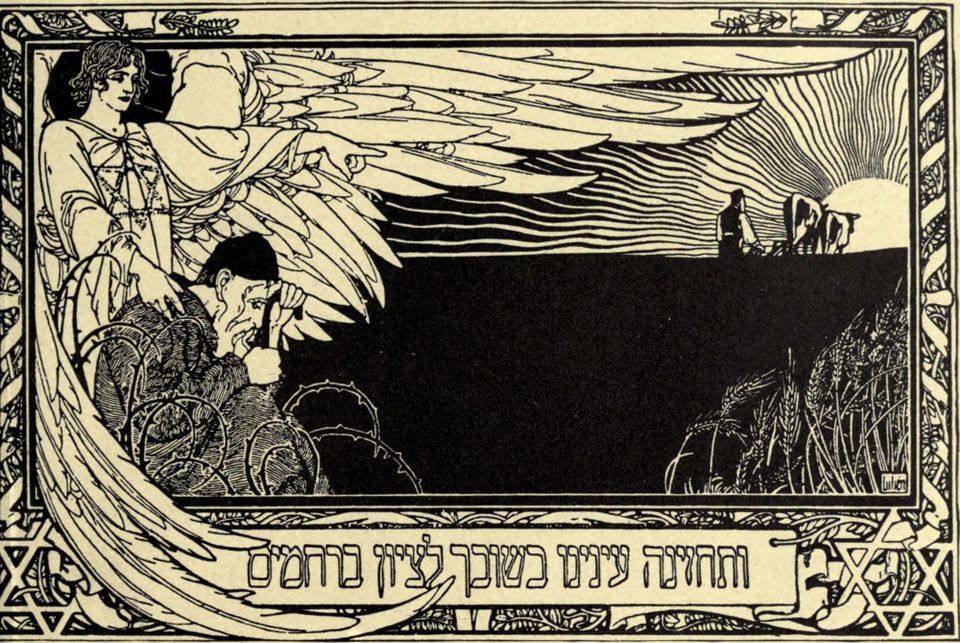
With the onset of Zionism, the profound spiritual history of the term Zion became flattened into a political program, i.e., the literal colonization of Palestine. The postcard at the top of this post embodies this Zionist framing perfectly. The artwork portrays a beleaguered diaspora Jew surrounded by barbed wire being comforted by an angel pointing him toward the land of Israel, where a settler plows a wheat field and a sun rises in the distance. The picture's caption is a messianic reference from the traditional Amidah prayer, "May our eyes behold Your return in mercy to Zion." In this one reductive image, the traditional messianic ideal of restoration to Zion is reframed into colonial settlement.
Needless to say, following the establishment of the state of Israel, the Zionist appropriation of sacred Jewish tradition would quickly became normalized for Jews throughout the world. I'd wager that for most people today, the concept of Zion and the institution of Zionism are inseparable. Given the complex and spiritually rich ways Zion has been imagined and reimagined throughout Jewish history, it's astonishing to consider how quickly these visions have regressed into the ethno-national settler colonial enterprise called Zionism.
I use the term "regress" very consciously here. While I'm mindful not to over-idealize or essentialize Judaism - Jewish messianism and mysticism certainly have deeply problematic aspects - I firmly believe that the Zionism's reframing of the term Zion represents a tragic backslide into an embrace of the toxic conquest tradition of the Bible. It is beyond ironic that the word Zion originally referred to a conquered Canaanite fortress before it developed into a larger and more spiritually complex theological concept. This has been a characteristic and defining element of Zionism: the material treatment of Biblical tradition as a literal history book - with inevitably tragic results.
And of course, the Palestinian people are paying the dearest price for this idolatrous hyper-literalism. Indeed, we can draw a straight line from the founding of Zionism in the late 19th century, to the Nakba in 1948, Israel's "liberation" of Jerusalem in 1967, and the current attempts by Israeli politicians and settlers to seize the Al-Aqsa mosque - and the entire Temple Mount. This program of systematic colonization is not the work of extremist leaders - it is the logical conclusion of political Zionism itself: an ideology and movement that has always understood Zion through possession and control rather than an abiding respect for the land's holiness and sanctity.
So yes, I understand completely when I hear that the term Zion in our liturgy can be dissonant and jarring for anti-Zionist Jews. But as I consider this question, the answer, it seems to me, is not to surgically excise this word from our tradition, nor is it to idealize a Jewish past that has been "sullied" by Zionism. Rather, I believe we must be guided by our ever-evolving spiritual tradition to develop a more universal idea of Zion: a deeper cherishing of the lands we consider sacred and a renewed ethic of how we might live well upon them. If Zion is truly to be our aspiration, it must embody a more universal spiritual vision where systems of conquest and colonization are dismantled and all peoples are free to express their connection to the land through reverence and care.
This is the vision I embrace every time I pray the words: "Let a new light shine upon Zion." So may it be.
Member discussion