The Global Sumud Flotilla and the Sacred Meaning of Solidarity
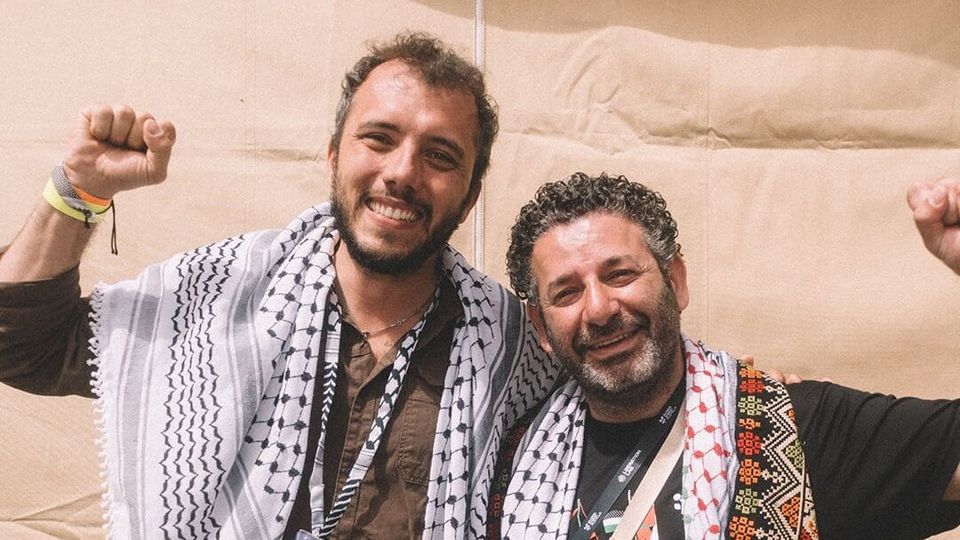
I’m increasingly hearing the claim that the Palestine solidarity movement is on the wane. Three years into Israel’s genocide in Gaza, and despite a constant cascade of actions, marches, rallies and protests, things in Palestine are worse than ever. The backlash from Israel, the US and Israel advocacy organizations has been fierce - and effective. Activists are growing tired and disillusioned. Or so the claim goes.
There’s no question that the situation facing Palestinians continues to be devastatingly dire. The genocide is most certainly not over. Israel has been repeatedly violating the so-called “ceasefire” and has killed well over 800 Palestinians in near-daily violence. Last week, Israel radio reported that the Israeli military has expanded its control of the Gaza Strip to nearly 60 percent of the territory as it prepares for a potential resumption of the war.
And yes, the backlash is all-too-real real. In the US and around the world, Palestine solidarity is becoming increasingly criminalized. University and college administrations have cracked down hard on the student encampment movement through the enactment of draconian policies and harsh punishments of student activists.
Despite it all however, I believe it's a mistake to view the movement for Palestinian solidarity as somehow on the ropes. Protests, actions - and tangible victories - are continuing to unfold at a steady pace. Just last week, protesters rallied outside a New York synagogue hosting a real estate sale for Israeli properties, including ones in the West Bank. The action was given public support by New York’s mayor Zohran Mamdani, who said the properties were “illegal under international law and deeply tied to the ongoing displacement of Palestinians.” (Would any of us have ever dreamed we would live long enough to hear words such as these from the mayor of New York City?)
Also in New York, over 300 protesters led by JVP-NYC staged a sit-in last month at the offices of Senators Chuck Schumer and Kirsten Gillibrand, shutting down traffic in mid-town Manhattan for over an hour as they demanded the senators block a bill authorizing the sale of US weapons to the Israeli military. (While the bill passed, an unprecedented 40 Democratic senators voted against it.)
On the same day as the Manhattan action, hundreds of activists rallied at the Venice Biennale, demanding that the Israeli pavilion be shut down. Nearly 200 artists, including some participating in this Biennale, signed a letter urging leadership to exclude Israel from the 2026 international exhibition. As the artists explained:
We do this in support of our fellow artists and cultural workers in Palestine, in solidarity with Palestine, and in profound hope of an end to Zionist genocide and ongoing apartheid, and the rebirth of a free Palestine.
Meanwhile, two important BDS victories recently occurred in Washington State when the Office of the State Treasurer divested $62 million in Caterpillar bonds and the Olympia City Council voted unanimously to add new language to its ethical investment policy to refrain from investing in entities that “engage in apartheid or illegal occupation.” Among other things, these actions represent an important measure of justice for Palestinian solidarity activist - and Olympia native - Rachel Corrie, who was killed in 2003 by a Caterpillar bulldozer in Rafah, Gaza.
And of course, if we needed any more evidence for the robust health of the Palestine Solidarity Movement, we should look no farther than the Gaza flotilla, one of the most powerful, relentless solidarity movements of the 21st century. It's most recent manifestation was launched by the Gaza Freedom Flotilla in June 2025, which sent out a vessel named the Madleen, seeking to break the blockade of Gaza and deliver humanitarian aid to the people of Gazan. In response, the Israeli Navy intercepted the boat in international waters, kidnapped, incarcerated and physically abused 12 flotilla activists (includng Swedish environmental activist Greta Thunberg).
This past April, various flotilla projects joined forces to send out its largest yet through the Global Sumud Flotilla, which launched over 70 boats and over a thousand participants from over 70 countries. Like last year’s flotillas, it was met violently by the force of the Israeli military. On April 30, the Israeli Navy intercepted more than a third of the flotilla's ships were hijacked in international waters near Crete, 600 miles from Israel’s shores. In the words of the flotilla’s spokesperson, Gur Tsabar, Israel’s actions amounted to “a straight-up attack on unarmed civilian boats... This is illegal under international law. Israel has no jurisdiction in these waters. Boarding these boats amounts to illegal detention – potentially kidnapping on the high seas.”
Activists were taken to an Israeli vessel, then to a Greek port where they were incarcerated and, according to their testimony, subjected to “severe physical and sexual abuse.” Eventually, all of the incarcerated activists were released except for two: Saif Abukeshek, a Spanish citizen who is a Palestinian and Thiago Ávila of Brazil. According to their lawyers, Ávila and Abukeshek reported being subjected to interrogations lasting up to eight hours, during which time they were beaten, insulted and forced to lie on their fronts with their forehead against the ground for hours at a time. After an Israeli court extended their incarceration, they initiated a hunger strike, refusing both food and water.
While the courageous solidarity of the GSF has largely been absent from the reportage of the corporate media, it has not escaped the world’s attention, with international protests organized in Spain, Italy and Turkey. The Spanish and Brazilian governments issued a joint statement demanding their release. In Greece, mass demonstrations broke out to protest the Greek government’s collusion with the Israel military to kidnap and imprison the activists. Finally, on May 10 the Israeli government announced it was “deporting” Ávila and Abukeshek.
In the meantime, the GSF has announced that the flotilla’s next fleet will be heading to Turkey, where more than 30 additional boats are expected to join ahead of an international assembly in Marmaris to expand the movement’s next phase and strengthening global Palestine solidarity efforts. According to leaders, “this assembly marks a decisive moment for the movement as GSF participants, organizers, partners, and international experts will be gathering to reassess, deepen political strategy, and sharpen the mission’s trajectory.”
In other words, this is not a movement that is on the wane.
The roots of GSF's actions date back to Gaza flotillas initiated in 2010, the year Israeli commandos infamously stormed the Mavi Marmara and killed ten activists (including 18 year old Furkan Doğan, a Turkish American citizen, who was shot repeatedly as he filmed the Israeli raid). For many, the attack on the Mavi Marmara was an important and galvanizing moment for the Palestine solidarity movement. It certainly was an important turning point in my own connection to Palestinian solidarity work. I vividly remember the horror I experienced upon reading the news of the massacre and Israel's vilification of the activists, inspiring me to publish a series of blog posts and articles about the incident.
As I consider Israel’s crackdown on flotilla activists sixteen years later, it seems clear to me that despite the numbing consistency of Israel’s brutal backlash, the Palestine solidarity movement has not simply held firm - it’s been growing through the steadfast, visionary leadership of a new generation of activists. I'm also mindful that liberation has never been a short or straight line. We know from history - and all-too current events - that historic victories don't ensure the end of the struggle. Rather than ask “why do we keep struggling if nothing ever seems to change?” I believe a more meaningful question is: “where do we find the strength and inspiration to keep on struggling when the odds against us are so daunting and so real?”
The short answer? We find it in one another. Those who have experience building movements of solidarity will attest that we must cultivate intra-movement solidarity if we are truly committed to organizing for the long haul. One of my most important role models of this ethic is Chicago organizer and journalist Kelly Hayes, who recently offered this critical wisdom in her newsletter, Organizing My Thoughts:
Survival is a collective process. We weren’t meant to do it alone, just as we weren’t meant to solve problems larger than ourselves alone. We are social beings who need each other to survive. Our courage and our potential are collective, and we will only find our way out of this together. So go to a meeting. Gather. Hold vigil. March. Talk to other people about what you do know and what you can do. Do not stop doing these things. Do not recoil and do not surrender.
At the same time, solidarity connects us outward - to people we may never meet or know personally - to remind oppressed people that they are not forgotten. Last Tuesday, it was reported that a large group of Gazans held a large rally in Gaza City to express their gratitude and solidarity with imprisoned flotilla activists Ávila and Abukeshek, proclaiming, “We wish them safety from all our hearts.” When I heard this news, it reminded me of the moving public messages of solidarity from Gazan university students sent to student campus encampment activists. These kinds of gestures demonstrate that true solidarity is not noblesse oblige, but rather a cultivation of genuine relationship and a culture of mutual struggle.
In other words, solidarity is not only a strategy, it is a sacred value, as many religious activists know all too well. In Jewish tradition, there's a famous debate in the Talmud, between the two great rabbis, Rabbi Akiba and Rabbi Ben Azzai about the central precept in Torah. Rabbi Akiba quotes the famous verse from Leviticus 19:18, “Love your neighbor as yourself.” But Ben Azzai disagrees, citing the verse from the Creation story, “God created humanity in God’s image.”
I believe the root of their conversation is a fundamental debate over particularist vs universalist solidarity. “Love your neighbor as yourself” could very well be taken to mean “love your fellow group member as yourself.” In fact, there are many prominent Jewish commentators who interpret it to mean “love your fellow Jew as yourself.” But as Ben Azzai chooses the teaching that humanity was created in God’s image to point out that all people are worthy of our love and solidarity.
Another way to look at this question is to insist that in our 21st century global reality, we must define “neighbors” not only as members of our immediate communities but to incorporate all who dwell on earth. Here I’m mindful of another famous verse from Leviticus, “Do not stand idly by the blood of your neighbor” (19:16) Those who put their bodies and lives on the line by boarding ships and sailing toward Gaza with humanitarian supplies were surely motivated by this spirit of universal solidarity. Even though they lived far from Gaza, they intrinsically viewed the Palestinian people as their neighbors - and could not stand idly by in the face of Israel's crushing blockade and deadly genocide.
Those who engage in acts of solidarity on this level do not do so with the expectation that their efforts will yield immediate results - they act because they know deep down that it is the only thing they can do. This was in fact, precisely what flotilla participant Hannah Smith said to Amy Goodman of Democracy Now last week:
I think the reason I went is the same reason a lot of us went, and that’s because we were done standing by, watching such injustice continue, watching such impunity continue, because we want to do the right thing, because we want to stand up for justice and humanity...I think a lot of us would, because this is — this is something that every citizen, everyone all around the world, whether you’re on land or sea, should be doing, that we should be standing for justice and standing for Palestine.
This is not to discount the importance of strategy. To be sure, leaders of successful solidarity movements constantly engage in tactical conversations, debating when to step forward, when to step back, when to pivot to a new approach. At the same time, however, longtime solidarity activists know that the path to liberation has never been linear or immediate. Yes, it can be deeply frustrating when it feels like nothing ever seems to change. Yes, it can be discouraging when despite our best efforts, the reality just seems to grow more and more dire around us. But while frustration and discouragement is natural, it cannot - it must not - lead us to despair.
Despite it all, we must embrace solidarity because we have no choice. We must embrace solidarity because in the end, it’s the only path that will lead us toward the world we are fighting for. We must embrace it because, as writer/playwright/historian Sarah Schulman put it so well in her book The Fantasy and Necessity of Solidarity:
As enraging as it is for so many people to be unheard while the suffering continues, solidarity is about getting ready for the change that we need right now. It does not deliver when we want it or need it, but there is nothing else that can bring us closer to a justifiable future.
Member discussion