Crying Out From the Rubble of Gaza

A series of midrashim (classical Jewish interpretive literature) imagine the horror of Egyptian enslavement as so extreme that the Israelites were literally interred - sometimes dead, sometimes alive - in the bricks of their own homes. (Yes, you read that right.) In one passage, for example, Rabbi Akiva teaches:
The executioners of Pharaoh used to strangle the Israelites (and place them) in the walls of their houses, and the Blessed Holy One heard their cry, as it is said, "And God heard their groaning, and God remembered his covenant with Abraham, with Isaac, and with Jacob." (Pirke De’Rabbi Eliezer 48:13)
Another midrash relates that when Uzza, the heavenly prince of Egypt, objected to God’s plans to drown Pharaoh’s army in the sea, God asked the angels to judge. So the angel Michael descended into Egypt and returned with “a brick with its clay enclosing a (dead) infant who had been immured alive in the structure … whereupon the Holy One sat in judgement over the Egyptians in accord with the measure of justice and drowned them in the sea.” (Sefer Aggadah 4:86)
I first encountered these midrashim decades ago - and their images have remained in my heart and my gut ever since, like a horror movie from your childhood that you just can’t shake. Encasing people in the walls of their own homes conveys a unspeakable level of sacrilege: profanely transforming a place of sacred shelter and security into a site that literally embodies sadism and brutality. It’s almost as if the writers wanted to conjure the most extreme cruelty they could possibly imagine to convey the depths of Pharaonic oppression, so that God's harsh judgement upon them could be justified.
I recalled the nightmarish vision of these wretched midrashim for the first time in years last week, as I watched a Democracy Now interview with Eyal Weizman on his new book, “Ungrounding: The Architecture of Genocide,” Weizman is the founder/director of the research group Forensic Architecture, a London-based institute that employs interdisciplinary methods to investigate state and corporate violence. (Their work featured prominently in the must-see 2024 Al-Jazeera documentary, “The Night Won’t End, in which they painstakingly reconstructed the Israeli military’s murder of Hind Rajab and her family.)
Weizman’s book analyzes, with deep detail, how Israel is systematically eradicating the structures, lived environments - and the very topography - of Gaza, ultimately erasing it - and the Palestinian people - from the map. As Weizman put it in the interview, “(Ungrounding) is a kind of destruction that erases the traces of destruction. It’s producing a kind of desertification, if you like, a kind of homogeneous piles of ruin that are unidentified by the people that inhabited that place before.”
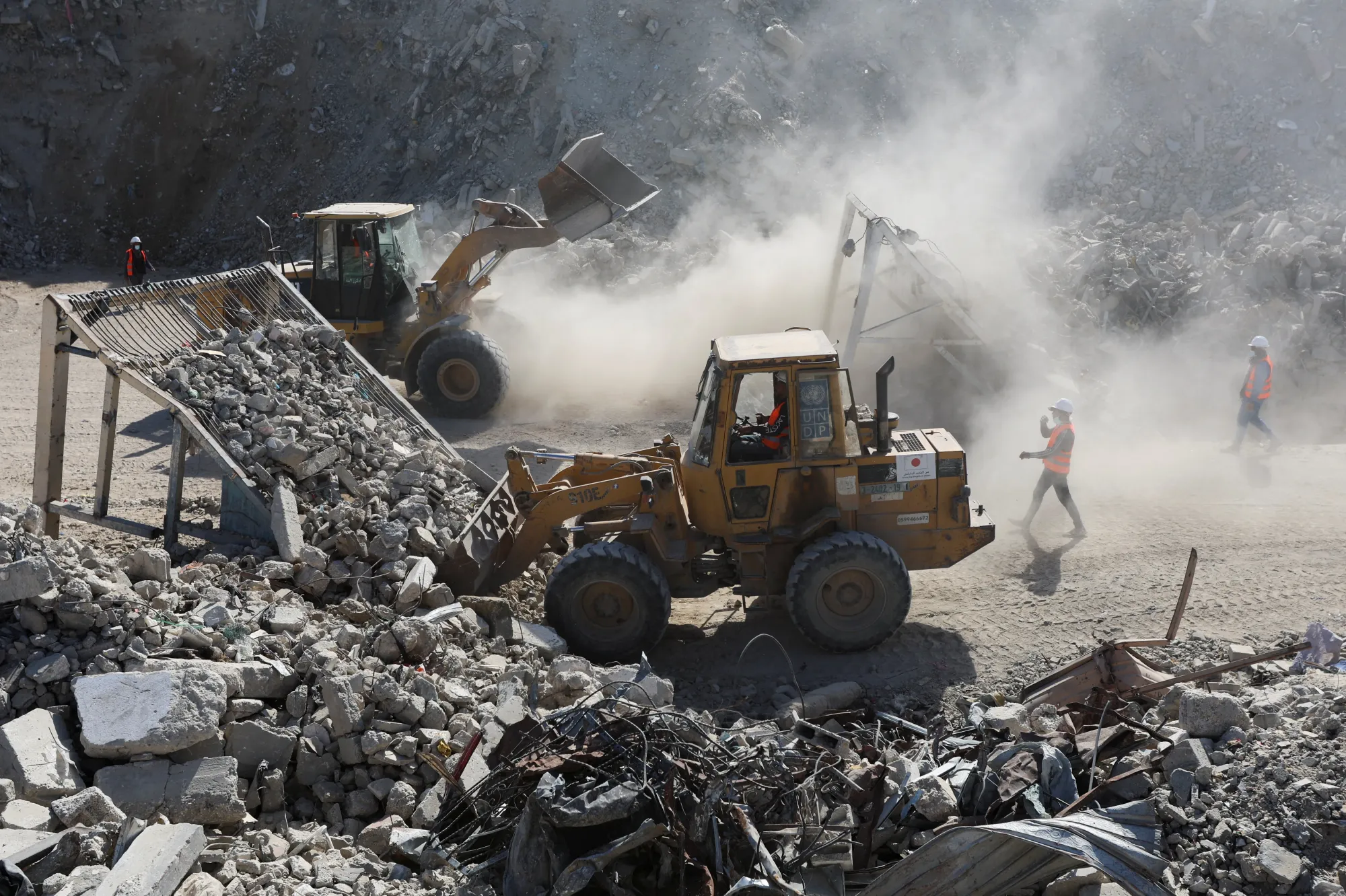
While the entire interview is critically important and worth listening to in its entirety, I can't stop thinking about one of Weitzman’s comments in particular. As he discussed the ongoing razing of bombed out homes and buildings by massive US-made, Israeli-operated Caterpillar earthmoving bulldozers, he observed:
Now, many of those homes were actually bombed during and before the so-called ceasefire. There are bodies. In fact, we are mapping the location of bodies of Palestinians that could not be extracted under the rubble of their own homes. We know there are about 10,000 Palestinians missing. Many of them are under the rubble. And when Israel is shuffling that rubble into all sorts of shapes and berms and military bases and roads, they are actually moving human remains.
This was the comment that stopped me in my tracks. Israel was bulldozing rubble filled with thousands of pulverized Palestinian bodies in order to erase any signs of their existence. Whatever arises from this completely razed territory, whether it’s the ghoulish “New Gaza” envisioned by Jared Kushner or the return of Israeli-Jewish settlement - or something else entirely - it will inevitably be built upon material and ground that literally contains the remains of its former inhabitants. But while those terrifying midrashim described mythic images, this reality is all-too real: i.e., collective actions that are unfolding before us even as I write these words. As Nehal Abu Hassan, who works with the World Food Program in Gaza has observed:
Rubble in some areas does not represent just debris to people; it represents their entire life and memories. In some cases, there may be bodies still under the rubble. That is why removing it is a very sensitive issue for families and communities.
As we contemplate the horror of this moment, it’s critical to bear in mind that this reality is not occurring in a vacuum. As Weizman points out in his new book, the Nakba itself was a systematic process of “ungrounding” - i.e., the destruction of Palestinian villages and neighborhoods and the subsequent creation of Jewish settlements, cities, towns and public spaces upon their ruins.
Several years ago, Forensic Architecture collaborated with the Palestinian organization Adalah, to document a May 1948 massacre in the northern coastal village of Tantur, in which it is estimated that more than 200 Palestinians were systematically murdered and buried in a mass grave that is now a parking lot at Israel’s popular Dor Beach. The atrocities at Tantur have been substantiated by Palestinian survivors and the former Israeli soldiers who carried them out. Their testimonies are central to the chilling 2022 documentary Tantura. (Unlike the Israeli perpetrator-doc of the moment, Naza, these war criminals aren’t interviewed anonymously, but confess to their acts openly and unabashedly.)
The literal building of new societies on the bodies of indigenous inhabitants is, of course, a hallmark of settler colonialism, and scholars have long documented multiple examples of this phenomenon in the context of Israeli settlement. Perhaps the best known - and most infamous - is the massacre at the Palestinian village Deir Yassin by Zionist militias. Although its inhabitants were buried in mass graves on the site, survivors attest that they still don’t know precisely where they are located. Deir Yassin is now part of the Israeli neighborhood of Givat Shaul and some of village's original buildings are now part of a public Israeli psychiatric hospital,
One of the least talked about examples of this phenomenon - for obvious reasons - is the Israeli destruction of the Mugrabi Quarter in the Old City of Jerusalem, which was razed in 1967 to make way for the plaza at the Western Wall. Established in 1193 for immigrants from western Tunisia, Algiers and Morocco, the Mugrabi Quarter (also known as the Morrocan Quarter) had a long and venerable history as a thriving Jerusalem neighborhood made up of Muslim and Jewish Mugrabi residents. By the 16th century, it was “a vibrant and diverse community (that) played an integral role in (Jerusalem’s) history and economic, social, spiritual and cultural life.”
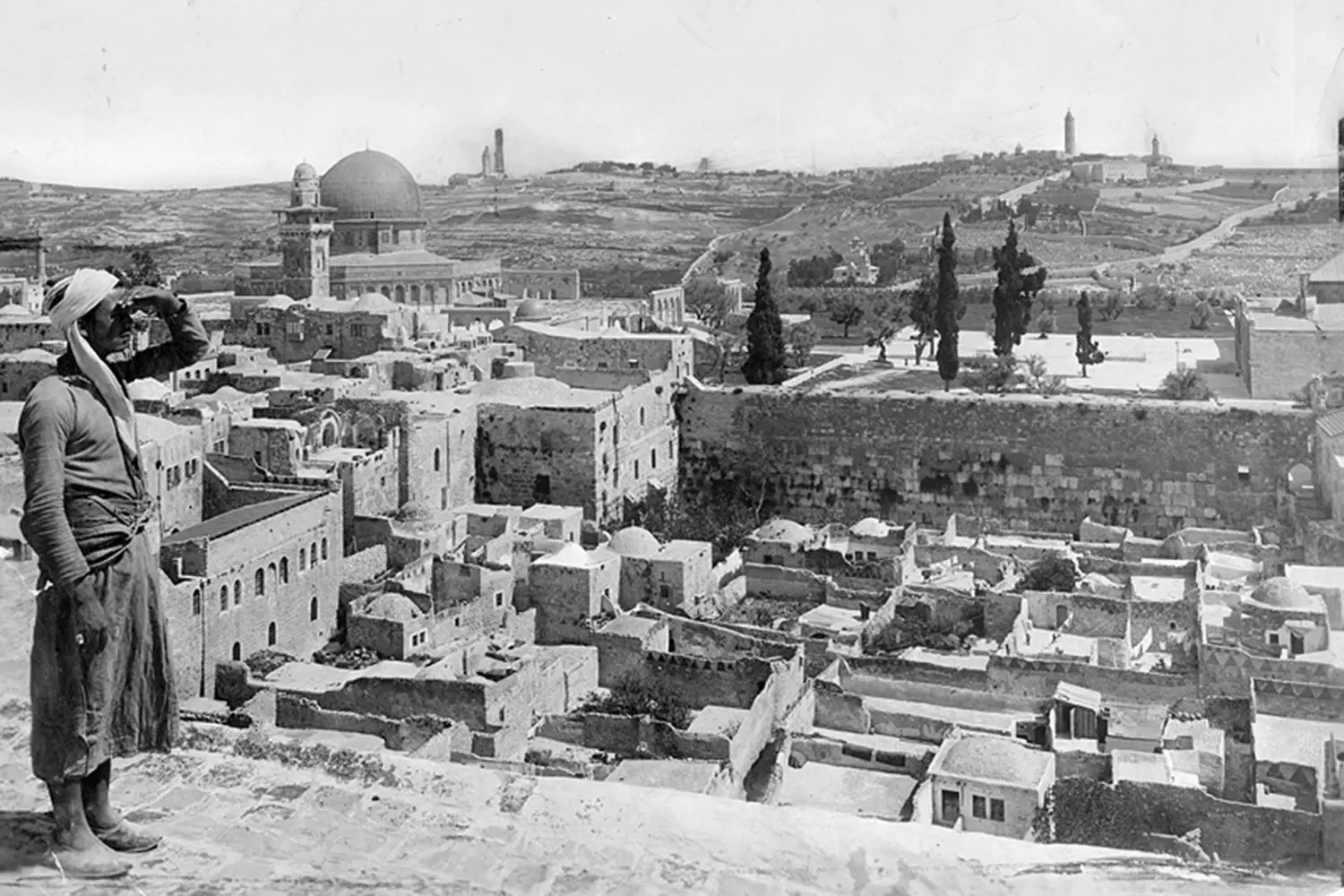
While freedom of Jewish worship at the Western Wall was granted by the Ottoman authorities, who enlarged a corridor in front of the wall to accomodate growing numbers of Jewish worshippers, the increase in Zionist immigration to Palestine in the 19th century caused the area to be a flashpoint for tension and violence. After the Nakba and the founding of the state of Israel, the Old City of Jerusalem was governed by Jordan, who denied Jewish access to the site entirely. When the Israeli army entered and occupied Jerusalem in 1967, there was strong Israeli fervor to create a large plaza in front of the Wall, which had become as much a nationalist symbol as a religious site.
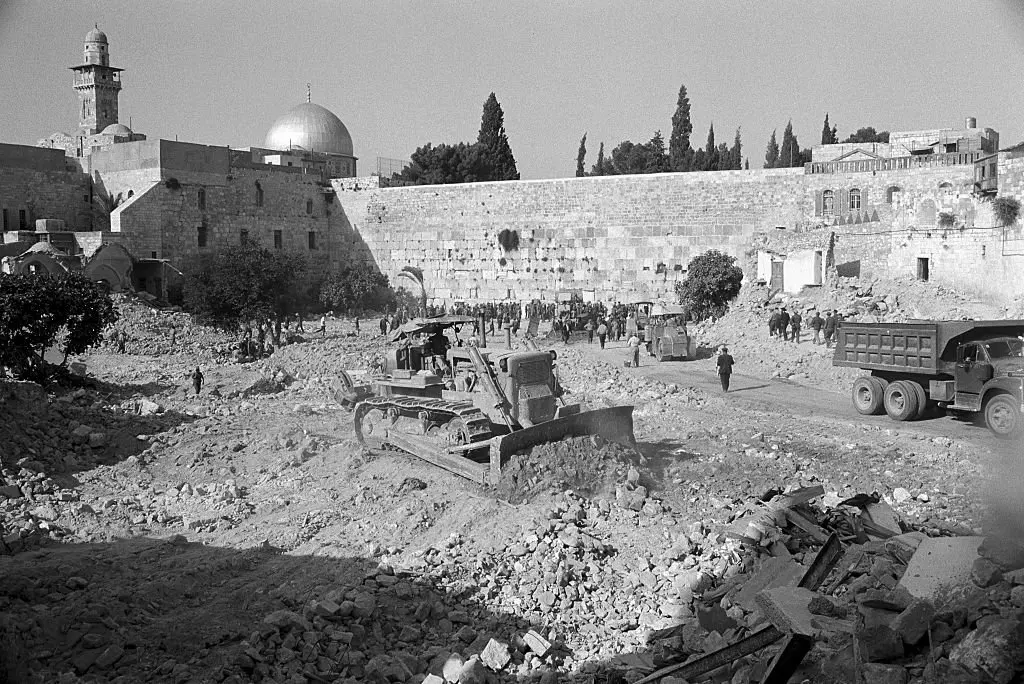
So on June 10, 1967, just three days after Israel entered the city, a demolition team razed the entire Mugrabi Quarter to the ground. At the time, it was the fifth largest of the 14 quarters in the Old City. Teddy Kollek, who was then the mayor of West Jerusalem, later wrote in his autobiography:
The day after the Old City fell, it also became clear to me that something had to be done about the small slum houses that crowded close to the Western Wall – the Moghrabi Quarter . . . The only answer was to do away with the slum hovels of the Moghrabi Quarter. I received the go-ahead from Herzog, Narkiss, and Dayan . . . My overpowering feeling was: do it now, it may be impossible to do it later, and it must be done. (from For Jerusalem: A Life, p. 197)
According to eyewitnesses, an army officer went from house to house ordering the residents to leave their homes immediately. When residents resisted, “a unit of reserve soldiers removed the residents by force.” When some residents still refused to leave, bulldozer drivers were ordered to start leveling the houses with families still inside them. Israeli authorities have acknowledged that one elderly woman, al-Jajja Rasmiyya Ali Taba’ki, was killed in her home during the demolition. Former residents have attested that she was not the only one. To this day, while millions of Jews the world flock to the Kotel as their central Jewish holy site, very few know (or care to know) that it is technically a crime scene, enabled by the ethnic cleansing and murder of its former inhabitants.
Jews, needless to say, should understand the reality of this unique sacrilege as well as anyone. In the post-Holocaust era, European soil has been forever contaminated with unmarked mass Jewish graves. While some European nations have created memorials at the sites where Jews were murdered en masse, the sheer scale of the genocide has ensured that untold numbers of Jewish bodies will be forever anonymously interred throughout the European landscape. Every once in a while we learn about a tragically unwitting discovery. In 2019, for instance, the construction of a Belarusian apartment complex was temporarily halted when they uncovered 1,214 human skeletons in the earth - the remains of Jews slaughtered by the Nazis in a June 1941 massacre. As the New York Times reported at the time:
Instead of the construction workers who for weeks had been preparing the foundations for a new luxury apartment project, soldiers in masks and gloves were pulling human skeletons from the earth. So many bones were coming out of the ground … it was immediately clear this was no ordinary crime scene.
In Gaza, we’re confronting this phenomenon in real time - and the international community allows it to continue with impunity. We may never truly know the scale of the devastation Israel continues to wreak on this tiny 140 square mile strip of land filled with 2,000,000 people. While Weitzman estimated that 10,000 bodies may still be under the rubble, other estimates have gone as high as 14,000. Last June, The International Committee of the Red Cross reported that thousands of Palestinians buried beneath Gaza’s rubble may never be identified because recovery efforts remain slow and many victims have yet to be retrieved.
According to Pat Griffiths, the ICRC spokesperson in Jerusalem:
There is no doubt that these bodies could soon become difficult to identify. The longer it takes for human remains to be recovered, the more difficult it can be to identify them. The longer the deceased lie beneath the rubble, the more likely they will be in advanced stages of decomposition – even skeletonised – when eventually recovered … Forensic experts lose access to circumstantial evidence that can be used to corroborate their identity.
As I consider the massive crimes unfolding in the Gaza Strip before an uncaring world, I can’t help but return to the image of murdered Israelites crying out to God from within the walls of their houses. According to this sacred Jewish teaching, their collective cry rose up to the heavens - and God responded with liberation.
The cries of the Palestinian people have been crying out to the world for far too long. Whether or not they are heeded is, as ever, up to us all.


Member discussion